Selena Quintanilla Red Dress Fashion Show
You lot have to start with the correct bra. If you start gluing rhinestones onto whatever old brassiere lying effectually, you're bound to fail. "It won't await the same," says Monica Peralta, a 27-year-erstwhile Selena fan from Los Angeles. "It really won't!" She recommends a sturdy bra from Victoria'south Hugger-mugger or Carnival Creations—i like Selena would have used.
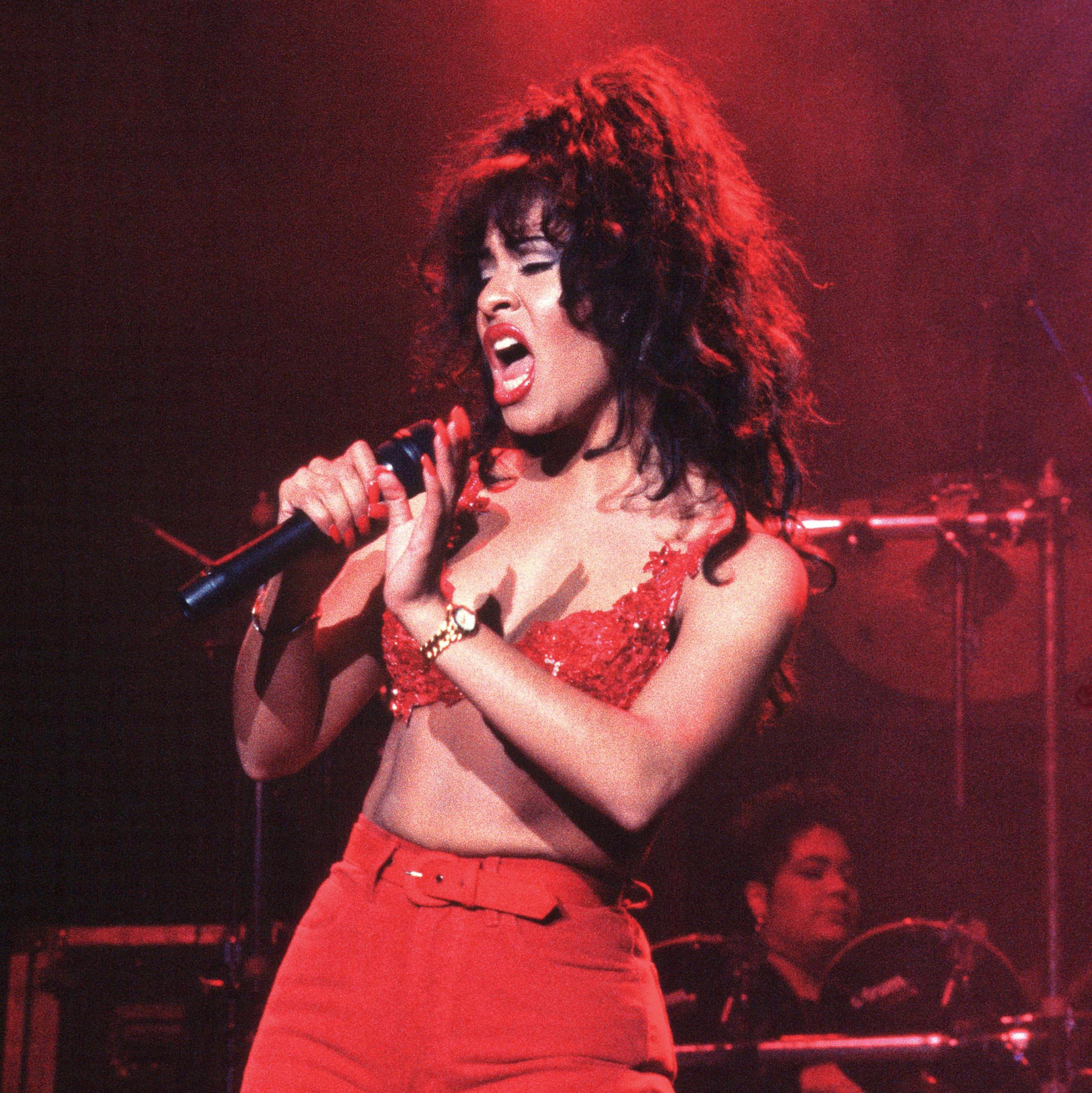
To recreate Selena's timeless, bejeweled bustiers, Peralta has studied countless photos, likewise as interviews with the late tejano vocaliser's family unit members, to glean clues as to how her intricate stage looks came together. On her YouTube aqueduct, which has more than than 10,000 followers, Peralta documents her process so that fans can larn how to pay homage to La Reina with meticulously embellished wearable. Over the years, she's delivered tutorials on how to replicate Selena's hair, makeup, statement hats—fifty-fifty the studded leather jacket she wore to the 1994 Tejano Music Awards. The demand for such tips makes clear that, for Selena devotees, at that place'due south much more to the vocalizer's appeal than but the music.
Today, her songs remain a force for many reasons, none more powerful than her insistence on simultaneously elevating Tejano culture and propelling it into the future. Though she wasn't raised speaking Spanish, early on in her career, she sang tejano songs phonetically in their traditional language. At the aforementioned time, she and her band stretched the definition of the genre by singing in English and working disco, R & B, and funk flourishes into her tunes.
Yet we rarely talk nearly how Selena's mode sensibility evoked a like tension. "I notice that Selena's interest in fashion ofttimes gets macerated to, 'Oh, she likes glitter,'" says Maria Garcia, the El Paso County–raised creator of public radio's Anything for Selena podcast. Such an attitude radically undersells how interesting Selena's way sense was. As in her music, she refused to accept the binary of staying truthful to your culture or eschewing information technology. She chose a unlike path, embracing her culture while also enervating that information technology evolve.

As a fashion icon, Selena unabashedly celebrated her Mexican American heritage rather than conforming to Eurocentric beauty standards. Few Latino celebrities made much headway in nineties American pop culture, and those who did often dealt with the cruelties of racism. In his autobiography, for example, Ricky Martin writes about never feeling truly comfortable on the set of General Infirmary, where he landed a role in the mid-nineties, and coming to believe his Puerto Rican accent sounded "horrible." Pop stars in the Mexican entertainment manufacture, such equally Paulina Rubio and Thalía, tended to accept fairer peel and lighter hair than Selena did. Both Rubio and Thalía attempted English language-language crossovers and played up their whiteness to varying degrees.
That is what made Selena so unlike, says Garcia. "At the fourth dimension, you never saw people like that on television, fifty-fifty in Latin American programming." Selena chose to emphasize the shape of her lips with a brilliant, signature red tint; she embraced her perennially frizzy, dark brown hair and her body blazon, which didn't fit a size-zero mold. (One episode of Anything for Selena is titled "Big Butt Politics.")
Today, Selena'due south paradigm is an essential part of American manner—which likely would have seemed unimaginable to her when she was trying to cleave out a infinite for herself in U.S. pop culture.
Selena's look mirrored the sartorial choices of Texas's Mexican American working-grade communities while simultaneously drawing on the influence of some of her pop star idols, such as Janet Jackson, Madonna, and Whitney Houston. Fifty-fifty when she was reaching for sophisticated styles, she did so on a budget. "She wore rhinestones that you could tell were rhinestones," Garcia says, laughing. "She wasn't trying to pretend that she was wearing diamonds." To create the splotches on the cow-print outfit she wore at a 1991 performance in San Antonio, she used blackness sequins available for buy at any craft store. She wore enough of denim, too, frequently opting for tight, black, loftier-waisted jeans onstage, and occasionally employing more rugged, calorie-free-washed varieties. Selena took everyday ranchero references and glammed them up a bit—such every bit that studded motorbike jacket that now sits in the Smithsonian's National Museum of American History. In Garcia'southward words, she "legitimized" these aesthetics, adorning Tejano touchstones and making them into something to be coveted and admired.
And while Selena'south clothes oft diameter a handcrafted element, they likewise had an elegant sheen. At the 1994 Grammys, where she won Best Mexican-American Anthology, she sported red lipstick and a teased updo, and wore a shimmering beaded gown. The image of her clutching her Grammy while effulgent at the camera cemented her condition as a new member of popular music royalty—a point driven dwelling house when Whitney Houston, who took habitation Anthology of the Yr and Record of the Year, graced the stage in a similar getup: a glistening, pearl-colored gown paired with a tousled updo.
Selena was shaped past the reigning artists of the day, especially the Black women whose music she was surrounded by during her babyhood. "She constantly cited Janet Jackson as an influence," both musically and visually, says Garcia. She frequently paid homage to Jackson, once introducing a cover of "Billie Jean" by telling the audience, "This little vocal is by Janet Jackson'southward blood brother." And the commencement fourth dimension she donned one of her bustiers onstage, she was covering Jackson'southward song "When I Think of You."
Martin Gomez, Selena'south manner designer, has said that Diana Ross served as an inspiration for some of the outfits he created for her. This influence is clear in what is arguably Selena's well-nigh well-known ensemble: the purple one-piece she wore to her last televised concert at the Astrodome, in 1995. With its bell-bottoms and midriff cutout, Selena was calling dorsum to the seventies—the era she came up in. Her clunky earrings and bold lipstick synced perfectly with the medley of disco songs with which the band started the prove. Selena was telling the world something about who she was: a Tejana who felt confident almost her roots, and i who best-selling her debt to Black forebears.
Selena'south outfits often challenged her family'due south conservative standards. Her father and manager, Abraham Quintanilla, frequently objected that her aesthetic choices were also revealing. In the 1997 Selena biopic, Abraham and his wife, Marcella, squabble about Selena's now-famous bustiers: "¡Es un bra!" he shouts in defiance.
As a breakout star in a male person-dominated genre, Selena ever had men weighing in on her prototype and her career ambitions. When she signed with EMI Latin, the label heads initially rejected her asking to record an English language-linguistic communication album, fifty-fifty though José Behar, the executive who signed her, had presented information technology to the Quintanillas as a singled-out possibility. Marketing decisions brutal to men, as well. Rubén Cubillos, who designed the cover for her debut anthology, has said he wanted to play up her "natural" features. Instead, the bizarre last product featured her walking through what appears to be a desert, washed up in an outfit that seems nonspecifically exotic. Over the years, equally she grew into distinction, Selena seized control of her epitome and established her own look. By the release of her tertiary album, Entre a Mi Mundo, listeners, as the title suggests, got to enter her globe—there, on the cover, is the Selena we know, in a bolero jacket, red lipstick, and gold earrings.
Emboldened by how influential her look became, Selena and Gomez launched a manner line in the early nineties and opened Selena Etc., a boutique with branches in Corpus Christi and San Antonio. Though much of Selena's career "had been tethered to her family's dreams," as Garcia notes, style offered her an outlet to make something truly her ain. The stores no longer be today, despite an unending public involvement in the details of Selena'due south life and no shortage of fans who seek to recreate her looks. Merely perhaps that'south because parts of her look accept since become ubiquitous. "People notwithstanding draw from that visual linguistic communication," Garcia says.
Today, Selena'south prototype is an essential part of American way—something that likely would have seemed unimaginable to her when she was trying to carve out a infinite for herself in U.S. popular culture. Search "Selena Quintanilla" on the online marketplace Etsy, and more than a thousand results for memorabilia—shirts, stickers, key chains, art—still come up up, many of them begetting her signature white rose. Celebrities such every bit Demi Lovato take shown off their Selena Halloween costumes on social media. And these days, Monica Peralta even so creates custom bustiers past request for fans who aren't as confident well-nigh their abode ec skills. "If Selena were here, I'thousand sure she would have hopped on the tendency of creating a YouTube aqueduct to talk to fans," says Peralta. "If that were the instance, I wouldn't have to be doing it myself."
Frida Garza is a writer and editor from El Paso who at present lives in Brooklyn. Her work has appeared in Guardian United states of america, Jezebel, ELLE.com, and more.
This article originally appeared in the Apr 2021 result ofTexas Monthlywith the headline "Selena, Fashionista." Subscribe today .
0 Response to "Selena Quintanilla Red Dress Fashion Show"
Post a Comment